Guitar pedals let you shape your tone with effects such as distortion, delay, reverb and more. This guide explains the most popular types, what they do and which pedals are worth considering. You don't need a large pedalboard to get started; choose one or two effects that suit how you want to play and build from there.
Tuner Pedals

A tuner pedal keeps your guitar accurately in tune and lets you mute the signal while tuning, making it one of the most practical additions to a pedalboard. The Boss TU-3 Chromatic Tuner offers a bright LED display and supports guitar, bass, alternative and drop tunings, making it a straightforward dedicated tuner for practice or live performance, but DigiTech Hardwire HT-6 Polyphonic Tuners can display the tuning of all six strings at once, allowing you to quickly identify which strings need adjustment, with support for standard, Drop-D and several bass tuning modes.
Pitch Shifting Pedals

Pitch-shifting pedals change the pitch of your guitar signal without physically retuning the instrument, making them useful for alternative tunings, octave effects and more dramatic pitch changes. DigiTech Drop Polyphonic Pedals can lower your guitar from one semitone to a full octave and offers momentary or latching operation, allowing you to switch tunings quickly or create temporary pitch effects during a performance.
Overdrive Pedals

Overdrive adds warmth, sustain and controlled breakup while retaining much of your guitar and amplifier's natural character. The Boss BD-2 Blues Driver produces responsive overdrive ranging from subtle grit to stronger blues and rock tones, while the Greer Amps Lightspeed Organic Overdrive focuses on a more transparent sound, adding smooth clipping and harmonic richness while preserving the underlying character of your guitar and amplifier.
Distortion & Fuzz Pedals

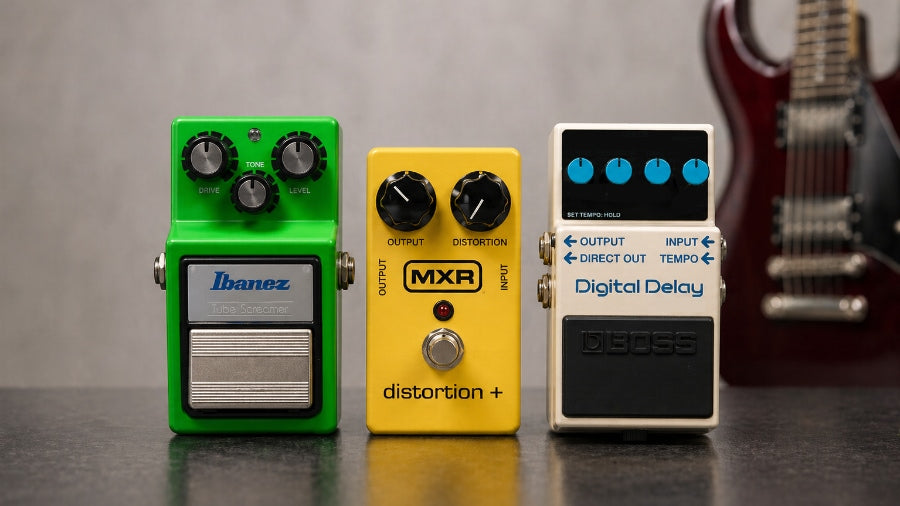
Distortion creates a heavier, more compressed sound than overdrive, while fuzz pushes the signal further for a thicker, rougher tone. The Boss DS-1 Distortion Effect Pedal ranges from moderate crunch to aggressive distortion with simple Distortion, Tone and Level controls, while the Dunlop FFM3 Fuzz Face Mini delivers the distinctive saturated character of the classic Fuzz Face in a compact format.
Delay Pedals

Delay repeats your guitar signal to create anything from subtle echoes to rhythmic and atmospheric textures. The Line 6 DL4 MKII offers 30 delay options, extensive preset control and two loopers for maximum versatility, while the Keeley HALO echo pedal combines two delay engines with rhythmic, analog-style and tape-style echoes for layered and ambient sounds. For a simpler approach, the MXR M169 Carbon Copy Delay provides warm analog repeats, up to 600ms of delay and optional modulation.
Reverb Pedals

Reverb recreates the natural reflections of rooms and larger spaces, adding anything from subtle depth to spacious atmospheric effects. While many amplifiers include basic reverb, the DigiTech Polara Reverb Pedal offers seven Lexicon reverb types, including Room, Hall, Plate, Spring, Modulated, Reverse and Halo, with controls for shaping the level, decay and character of the effect, plus a tails mode for natural fade-outs.
Chorus Pedals
Chorus creates the impression of multiple instruments playing together by adding slightly delayed and detuned copies of your guitar signal. This produces a wider, richer sound that works particularly well with clean chords, arpeggios and melodic playing. Use it subtly for extra depth or more heavily for the distinctive shimmering sound associated with many classic guitar tones.
Compressor Pedals

A compressor reduces the difference between louder and quieter notes, creating a more consistent sound and often adding sustain, which is particularly useful for clean playing, fingerstyle, funk and recording. The Keeley Compressor Plus adds Blend control for mixing the compressed and natural signals, plus a switch for adjusting its response to single-coil or humbucker pickups, helping even out dynamics without losing the natural character of your playing.
Wah Pedal
A wah pedal uses a foot-controlled filter to sweep through different frequencies, creating its distinctive vowel-like “wah” sound. Unlike effects that remain relatively constant, wah is controlled while you play, making it an expressive tool for lead guitar, riffs and rhythmic parts. Moving the pedal slowly creates broader tonal changes, while faster movements produce the more obvious wah effect.
Looper Pedals
A looper records a phrase and repeats it continuously, allowing you to layer additional guitar parts over it. Beyond live performance, loopers are useful for practising timing, chord changes and improvisation, as well as experimenting with songwriting and arrangements.
Multi-Effect & Amp Modelling Pedals

Multi-effect and amp modelling pedals combine multiple sounds or parts of a guitar rig into one unit, reducing the need for separate pedals, amplifiers or cabinets. The Line 6 HX Stomp combines more than 300 amp, cabinet and effect models and can function as a complete guitar rig or recording interface; the Two Notes Torpedo C.A.B. M+ Speaker Simulator focuses on cabinet, microphone and room simulation for direct recording or PA use; while the compact IK Multimedia Tone X One provides amp, cabinet and pedal modelling alongside effects, a tuner and USB recording, with storage for up to 20 Tone Model presets.
EQ Pedals

An EQ pedal lets you boost or cut specific frequencies to shape your guitar tone, reduce muddiness or harshness, compensate for different equipment or create a focused solo boost. The Boss GE-7 EQ Pedal provides seven adjustable frequency bands with up to ±15 dB of boost or cut, plus a separate level control for precise tone shaping or clean boosting.
Which Guitar Pedals Do You Actually Need?
You don't need a large pedalboard to start experimenting with effects. A tuner is the most practical first pedal, while your next choice should depend on the sound you want. Choose overdrive, distortion or fuzz for driven tones; delay or reverb for space and ambience; chorus for width and movement; or a looper for practice, songwriting and layered performances. A compressor or EQ is useful when you want greater control over your existing tone, while a multi-effects unit is a good option if you want to explore many sounds before committing to individual pedals.
Turn Your Guitar Tone Into Music

Pedals can transform your sound, but they're most useful when you're actually playing music. The Fingerstyle Guitar Songbook gives you 82 beginner-to-intermediate guitar tabs designed to develop your timing, accuracy and fingerstyle technique while building a repertoire of songs you can actually play. The collection includes nursery rhymes, classical pieces, folk songs and traditional melodies, clearly arranged for acoustic or electric guitar in standard tuning.